
Consider a Mixture of Experts
Stop Asking “Which AI Should I Use?” Start Thinking Like a Mixture of Experts.
The most valuable AI skill for a small business owner isn’t knowing the best tool. It’s knowing how to route the right problem to the right expertise. Here’s why that shift matters — and how to put it to work.
TL;DR
Different AI tools are pulling ahead at different things, and chasing the single “best” one is a losing game. A more durable approach borrows from how the newest models are actually built — a Mixture of Experts (MoE) that routes each task to the specialists it needs. Adopt that mindset and the question changes from “Which AI should I use?” to “Which expertise does this problem need?” That’s a teachable skill, and it outlasts any single tool.
Every AI tool is becoming a specialist
If you use AI in your business, you’ve probably noticed something: the major tools are no longer interchangeable. As they mature, each one is developing a personality — a set of things it does noticeably better than the rest.
In my own daily work, the pattern looks roughly like this:
- Claude tends to shine on long-form document analysis and careful, strategic reasoning — the kind of thinking where you want a patient second brain.
- ChatGPT is strong for interactive, back-and-forth collaboration and structured business problem-solving.
- Gemini earns its place when you’re already working inside the Google ecosystem.
- Perplexity is my reach-for tool when I need research and source discovery I can actually trace.
Knowing these strengths is a genuinely useful starting point. If all you do is match the tool to the task, you’re already ahead of most people. But it’s a starting point — not the whole game.
A quick-reference comparison
Here’s how the leading tools tend to sort out by strength. Think of this as a routing cheat-sheet, not a leaderboard — the names move around, but the task-fit logic holds.
| Tool | Tends to lead at | Reach for it when… | Keep in mind |
|---|---|---|---|
| Claude | Long-form analysis, careful writing, strategic reasoning, agentic work | You’re working through a long document, drafting something that has to sound like you, or thinking through a decision | Less focused on real-time web by default |
| ChatGPT | Versatile all-rounder, brainstorming, interactive collaboration | You want a flexible daily driver for quick tasks and back-and-forth idea work | Verify factual claims before they go out the door |
| Gemini | Google Workspace integration, current information, long context | Your work already lives in Docs, Sheets, and Gmail, or you need very recent data | Strongest when you’re inside the Google ecosystem |
| Perplexity | Research and source discovery with citations | You need answers you can trace back to a verifiable source | A research companion more than a drafting tool |
| Microsoft Copilot | Microsoft 365 integration (Word, Excel, Outlook, Teams) | Your business runs on Microsoft’s suite and you want AI inside those apps | Most valuable when you’re already a 365 shop |
Treat every output as a first draft that deserves a human check — especially anything going to a client or to leadership.
A better question than “which tool?”
There’s a deeper idea worth sitting with, and it comes from how the most advanced models are now being built. It’s called a Mixture of Experts, or MoE.
The insight that stuck with me is this: the advantage may not belong to whoever picks the single best AI. It may belong to whoever is best at routing each problem to the right kind of expertise. When you internalize that, the question you ask quietly changes.
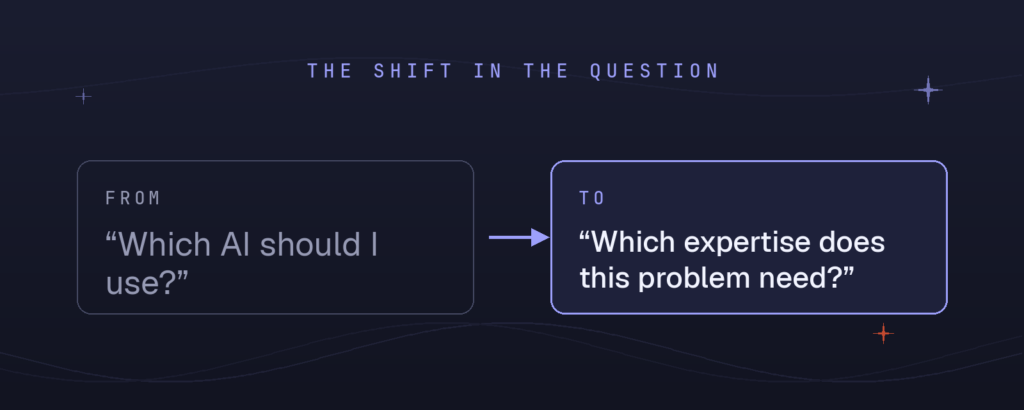
“Which AI should I use?” puts the tool at the center. “Which expertise does this problem need?” puts the problem at the center — and lets the right tool fall out of that answer. It’s a small reframe with large consequences, especially if you advise or mentor other people. It’s the difference between being an answer provider and being the person who knows where the answer should come from.
So what is a Mixture of Experts, really?
At a technical level, a Mixture of Experts is an AI architecture in which a routing system activates only the most relevant “experts” for a given task — instead of running the entire model every single time. The model is made of many specialized sub-networks, and a router decides which ones to wake up for the job in front of it.
You don’t need the engineering to use the idea. The cleanest way to picture it is a well-run consulting firm.
A tax question doesn’t go to the web designer. A lead-generation problem doesn’t start with the CFO. The manager’s real skill is knowing who to hand the problem to.
That’s MoE in plain language. And notice the efficiency: the firm doesn’t put every employee on every question. It routes. The same principle is what makes modern AI models faster and more capable — and it’s the same principle you can borrow for how you work.
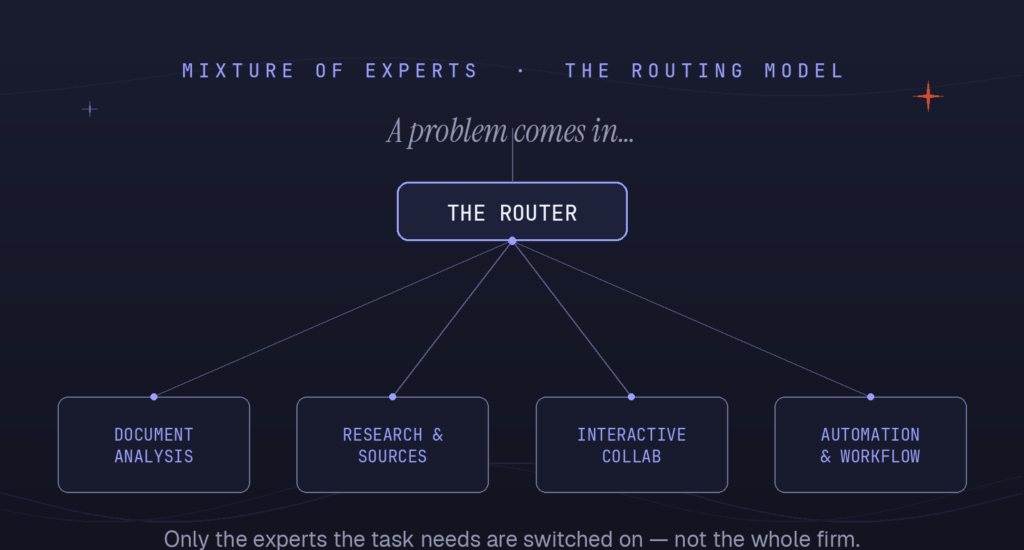
It’s worth knowing that MoE shows up in two places. It can live inside a single model — architectures like Llama and DeepSeek use it under the hood. And it can live in your process, completely independent of any one model: you, acting as the router, sending each task to whichever tool or method is the right expert for it. The second kind is the one you can start using today.
How to apply MoE thinking in your business
Here’s a simple way to put the routing mindset to work. It doesn’t require new software — just a different first move.
01 — Name the problem before naming the tool
Before you open any app, finish this sentence: “The expertise this task really needs is…” Analysis? Research? A creative collaborator? Summarizing a long document? Naming the expertise first stops you defaulting to whatever tool you happen to have open.
02 — Match the expertise to a specialist
Once you know the kind of help you need, the tool choice gets easy. Deep document reasoning leans one way; fast sourced research leans another. Keep a short mental map of which tool is strong at what — and update it as the tools change.
03 — Route, don’t marry
You are not looking for one tool to rule them all. You’re building the habit of sending each job to the best-fit expert. The goal is range, not loyalty.
04 — Keep the router — you — sharp
The tools will keep changing. The routing skill is the durable asset. The more deliberately you practice it, the less it matters which model is “best” this month.
Three worked examples
The framework is easier to feel than to describe. Here are three everyday situations — watch how naming the expertise first makes the tool choice almost obvious.
The tax preparer — “I’m drowning in client follow-ups and a 40-page IRS update.”
It’s a busy week. There’s a long piece of IRS guidance to digest, a stack of client emails to send, and a firm FAQ page that’s been on the to-do list for months. One tool won’t do all of this well — but routing makes it simple.
- Digest the 40-page doc → Claude
- Verify a specific rule + source → Perplexity
- Draft the client follow-up emails → Claude or ChatGPT
Three different kinds of expertise, three quick routes. What felt like a wall of work becomes a sequence of 10-minute tasks.
The real estate agent — “I need a listing live tonight and a read on the local market.”
A new listing needs compelling copy, the pricing needs to be defensible with real comps, and everything has to fit into the Google Workspace the brokerage already runs on.
- Pull recent comps with sources → Perplexity
- Brainstorm + refine listing copy → ChatGPT
- Drop it into Docs & share → Gemini
The agent isn’t loyal to one app — they’re routing each step to the specialist that handles it best, and finishing in one evening.
The independent consultant — “I’m building a proposal that has to actually win the client.”
A strong proposal needs research on the prospect’s industry, a sharp strategic narrative, and clean financials — each a different kind of expertise.
- Research the prospect’s industry → Perplexity
- Shape the strategy & narrative → Claude
- Model the numbers in a spreadsheet → Copilot or Gemini
No single tool is the “winner” here. The consultant’s edge is being the router who knows which part goes where.
Why this matters more for small businesses and mentors
Large companies can afford to standardize on one platform and train everyone on it. A small business owner doesn’t have that luxury — and honestly doesn’t need it. Your advantage is agility: you can route a contract review to one tool in the morning and a marketing brainstorm to another in the afternoon, with no committee in the way.
And if you mentor or advise others, the routing mindset is what keeps you valuable as the tools churn. Anyone can hand someone a list of apps. The person who can look at a real problem and say “here’s the kind of expertise that needs, and here’s where to get it” is doing something far more durable than tool recommendations.
The tools will change. The skill won’t.
A year from now the names at the top may be different. New models will arrive, current ones will leapfrog each other, and today’s clear winner in any category may not hold the lead. None of that threatens the routing skill. If anything, it makes it more valuable — because the better you are at matching problems to expertise, the less you depend on any single tool staying ahead.
That’s why I’ve started calling it “MoE Mode.” Not because you need to understand the architecture, but because the mindset — route the problem to the right expert — is the most future-proof AI habit a small business owner can build.
Frequently asked questions
What does MoE (Mixture of Experts) mean in simple terms?
It’s an AI design where a router turns on only the specialist parts of the model a task actually needs, instead of using the whole model every time — like a consulting firm assigning the right specialist to each client question rather than putting the entire staff on every job.
Do I need a technical background to use this idea?
No. The architecture is technical, but the principle is not. You apply it simply by asking “which expertise does this problem need?” before you pick a tool, and then routing the task accordingly.
Which AI tool is the best one for small business?
There isn’t a single best one, and that’s the point of this article. Different tools lead at different tasks. The more useful question is which kind of expertise a given task needs — and matching the tool to that.
How do I figure out which tool to use for what?
Start by naming the type of help the task needs (analysis, research, collaboration, automation), keep a simple map of which tools are strong in each area, and revisit it as the tools evolve. If you’d like help building that map for your specific business, that’s exactly what a one-on-one session is for.
Work with me
Want help routing your own work? In one focused hour, we’ll look at your actual work, find where AI fits, and build you a simple way to decide what goes where. No jargon, no course, no obligation.
Book your first session — $75 → https://rcdmstudio.com/the-ai-whisperer/
Learn more — https://rcdmstudio.com/the-ai-whisperer-one-on-one-ai-coaching-for-small-business-owners/
